
Squid
Research status: AI draft — awaiting expert review


Overview
Squid is a marine cephalopod sold whole, cleaned as tubes and tentacles, or cut into rings, often labeled calamari. The mantle (body), fins, and tentacles are edible; size varies considerably by species.
Origin & cultivation
Most commercial squid is wild-caught in coastal and open-ocean waters. Major fishing and supplying regions include China, Taiwan, Japan, South Korea, Peru, and Argentina, with substantial fisheries elsewhere.
Season
Fresh squid availability follows local species, migrations, weather, and fishing seasons, so there is no single worldwide peak season. Frozen squid is available year-round and can be an excellent alternative to fresh.
Texture & flavor
Squid has a mild, slightly sweet, briny flavor and firm, springy flesh. It becomes rubbery with intermediate cooking times, so quick cooking or prolonged gentle simmering generally gives the best texture.
Nutrition
Typical values estimated with AI, not yet checked against lab data. For guidance only.
| Energy | 92 kcal | raw, per 100 g edible portion | FoodPulse AI estimate |
| Protein | 15.58 g | raw, per 100 g edible portion | FoodPulse AI estimate |
| Total fat | 1.38 g | raw, per 100 g edible portion | FoodPulse AI estimate |
| Saturated fat | 0.358 g | raw, per 100 g edible portion | FoodPulse AI estimate |
| Carbohydrate | 3.08 g | raw, per 100 g edible portion | FoodPulse AI estimate |
| Dietary fiber | 0 g | raw, per 100 g edible portion | FoodPulse AI estimate |
| Total sugars | 0 g | raw, per 100 g edible portion | FoodPulse AI estimate |
| Water | 78.55 g | raw, per 100 g edible portion | FoodPulse AI estimate |
| Calcium | 32 mg | raw, per 100 g edible portion | FoodPulse AI estimate |
| Iron | 0.68 mg | raw, per 100 g edible portion | FoodPulse AI estimate |
| Magnesium | 33 mg | raw, per 100 g edible portion | FoodPulse AI estimate |
| Potassium | 246 mg | raw, per 100 g edible portion | FoodPulse AI estimate |
| Sodium | 44 mg | raw, per 100 g edible portion | FoodPulse AI estimate |
| Zinc | 1.53 mg | raw, per 100 g edible portion | FoodPulse AI estimate |
| Vitamin C | 4.7 mg | raw, per 100 g edible portion | FoodPulse AI estimate |
| Vitamin A (RAE) | 10 µg | raw, per 100 g edible portion | FoodPulse AI estimate |
| Folate | 5 µg | raw, per 100 g edible portion | FoodPulse AI estimate |
| Vitamin B12 | 1.3 µg | raw, per 100 g edible portion | FoodPulse AI estimate |
| Cholesterol | 233 mg | raw, per 100 g edible portion | FoodPulse AI estimate |
Glycemic index: Not applicable / not meaningful (very little carbohydrate).
Squid provides protein, vitamin B12, selenium, and other nutrients, and is generally a lower-mercury seafood choice; frying and salty sauces can substantially change its nutritional profile. Squid is a molluscan shellfish allergen, and people with seafood allergies should seek individualized advice rather than assume it is safe. Educational, not medical advice.
Educational information, not medical advice.
Storage
- Room temperature — handling or serving only · Above 40°F (4°C); especially above 90°F (32°C) · No more than 2 hours total outside refrigeration, or 1 hour above 90°F (32°C).. Keep chilled until needed. Discard after these limits even if it smells normal; appearance and odor cannot reliably reveal harmful bacteria. FoodPulse AI estimate
- Refrigerator · 32–40°F (0–4°C) · Raw squid: 1–2 days; cooked squid: 3–4 days.. Store covered in a leakproof container, with raw squid below ready-to-eat foods. Refrigerate cooked squid promptly in shallow containers. Discard for sour or ammonia-like odors, unusual discoloration, or excessive slime, and do not taste to check safety. FoodPulse AI estimate
- Freezer · 0°F (−18°C) or below · For best quality, use raw squid within 3–6 months and cooked squid within 2–3 months.. Freeze promptly in airtight, meal-size packages. Continuously frozen food remains safe beyond these quality windows, although freezer burn can impair texture. Thaw in the refrigerator; discard if thawed squid has spoilage signs or has exceeded safe room-temperature limits. FoodPulse AI estimate
Preparation
Thaw in the refrigerator, then pull out the head and innards, remove the transparent quill, and discard the beak from the tentacle cluster; peel the skin if desired. Briefly rinse away remaining grit or viscera under cold water with minimal splashing, pat dry, and cut the tube into rings or open it flat for shallow scoring. Keep raw squid and its juices away from ready-to-eat foods, and wash hands, knives, boards, and sinks after handling.
Cooking
Grill, stir-fry, or sauté thin rings and small tentacles for roughly 1–3 minutes, or small whole cleaned squid for about 3–5 minutes, depending on thickness and heat. Alternatively, gently braise for approximately 30–60 minutes until tender, allowing longer for large, thick pieces. Follow USDA seafood guidance by cooking to an internal temperature of 145°F (63°C), checked in the thickest part with a food thermometer; time alone is not a safety test.
Recipes
No verified recipes yet.
Waste less
Use the fins and tentacles along with the tubes, and save clean edible trimmings for seafood stock. Refrigerate cooked leftovers promptly and use in soups, pasta, or salads within 3–4 days; reheat hot dishes to 165°F (74°C). Do not put raw or cooked seafood scraps in a typical home compost pile; use a municipal food-waste service only if it accepts them.
Food waste tips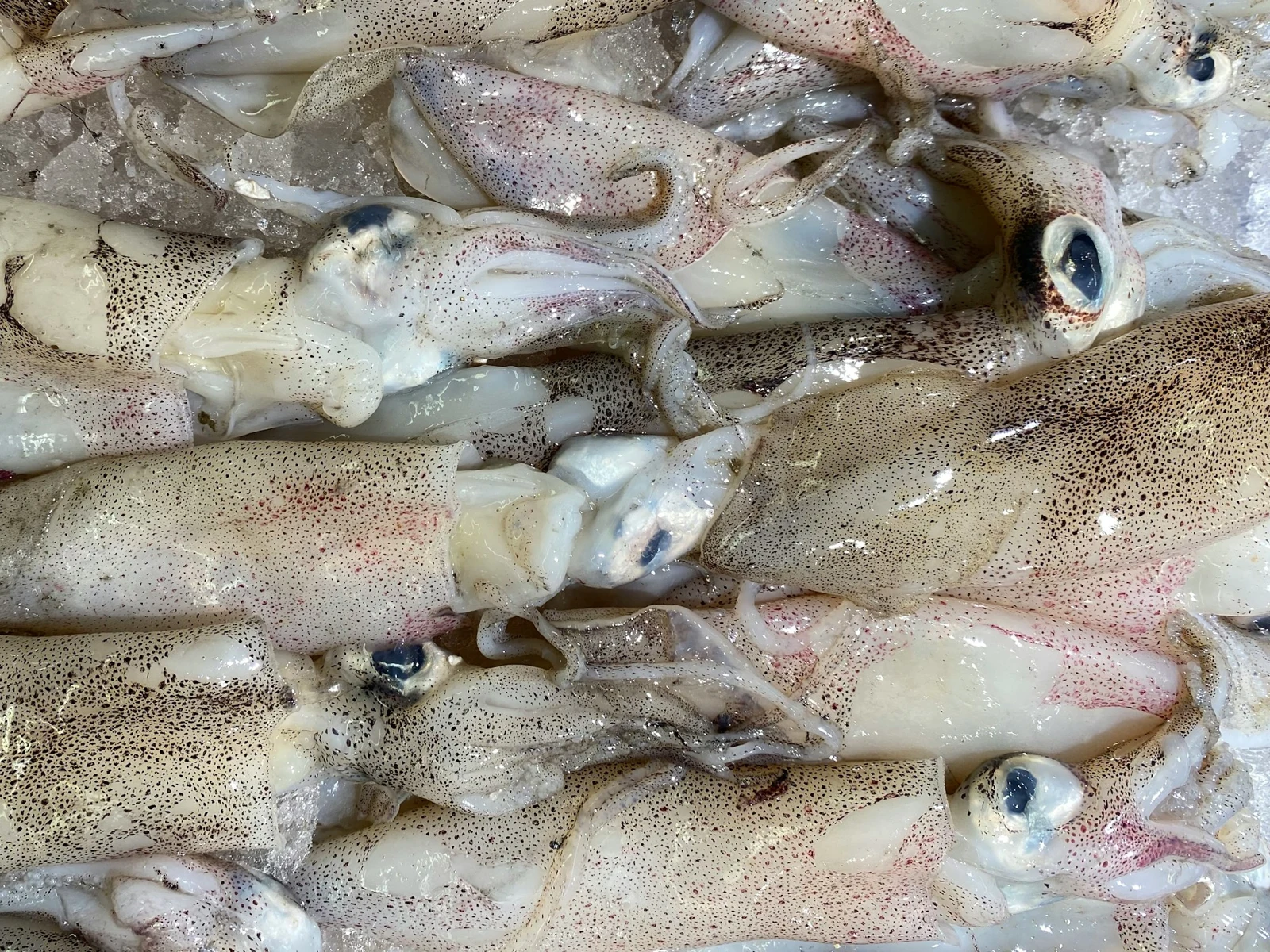 Squid - Calamari