
Duck
Research status: AI draft — awaiting expert review


Overview
Duck is poultry sold whole or as breasts, legs, wings, and ground meat. Its relatively thick layer of fat and dark meat make it well suited to roasting, braising, and pan-searing.
Origin & cultivation
Most domestic meat ducks descend from mallards; Muscovy ducks originate in the Americas. China is by far the largest producer, with substantial production elsewhere in Asia and in European countries such as France and Hungary.
Season
Farmed duck is available year-round, usually fresh or frozen. Availability may increase around autumn and winter holidays; wild duck availability depends on local hunting seasons and regulations.
Texture & flavor
Duck has a richer, more pronounced flavor than chicken, with firm breast meat and connective-tissue-rich legs that become tender with slow cooking. The skin can become crisp when its underlying fat is rendered; wild duck is generally leaner and more strongly flavored.
Nutrition
Typical values estimated with AI, not yet checked against lab data. For guidance only.
| Energy | 404 kcal | raw, domesticated duck, meat and skin, per 100 g edible portion | FoodPulse AI estimate |
| Protein | 11.49 g | raw, domesticated duck, meat and skin, per 100 g edible portion | FoodPulse AI estimate |
| Total fat | 39.34 g | raw, domesticated duck, meat and skin, per 100 g edible portion | FoodPulse AI estimate |
| Saturated fat | 13.22 g | raw, domesticated duck, meat and skin, per 100 g edible portion | FoodPulse AI estimate |
| Carbohydrate | 0 g | raw, domesticated duck, meat and skin, per 100 g edible portion | FoodPulse AI estimate |
| Dietary fiber | 0 g | raw, domesticated duck, meat and skin, per 100 g edible portion | FoodPulse AI estimate |
| Total sugars | 0 g | raw, domesticated duck, meat and skin, per 100 g edible portion | FoodPulse AI estimate |
| Water | 48.5 g | raw, domesticated duck, meat and skin, per 100 g edible portion | FoodPulse AI estimate |
| Calcium | 11 mg | raw, domesticated duck, meat and skin, per 100 g edible portion | FoodPulse AI estimate |
| Iron | 2.4 mg | raw, domesticated duck, meat and skin, per 100 g edible portion | FoodPulse AI estimate |
| Magnesium | 15 mg | raw, domesticated duck, meat and skin, per 100 g edible portion | FoodPulse AI estimate |
| Potassium | 209 mg | raw, domesticated duck, meat and skin, per 100 g edible portion | FoodPulse AI estimate |
| Sodium | 63 mg | raw, domesticated duck, meat and skin, per 100 g edible portion | FoodPulse AI estimate |
| Zinc | 1.36 mg | raw, domesticated duck, meat and skin, per 100 g edible portion | FoodPulse AI estimate |
| Vitamin C | 2.8 mg | raw, domesticated duck, meat and skin, per 100 g edible portion | FoodPulse AI estimate |
| Vitamin A (RAE) | 50 µg | raw, domesticated duck, meat and skin, per 100 g edible portion | FoodPulse AI estimate |
| Folate | 13 µg | raw, domesticated duck, meat and skin, per 100 g edible portion | FoodPulse AI estimate |
| Vitamin B12 | 0.3 µg | raw, domesticated duck, meat and skin, per 100 g edible portion | FoodPulse AI estimate |
| Cholesterol | 76 mg | raw, domesticated duck, meat and skin, per 100 g edible portion | FoodPulse AI estimate |
Glycemic index: Not applicable / not meaningful (very little carbohydrate).
Duck supplies protein, iron, zinc, and vitamin B12; eating the skin adds substantial fat, including saturated fat. Duck allergy is possible, and marinades, sauces, or processed products may contain allergens such as soy, wheat, or milk. Educational, not medical advice.
Educational information, not medical advice.
Storage
- Room temperature — preparation and serving only · 40–140°F (4–60°C), the food-safety danger zone · No more than 2 hours total, or 1 hour when ambient temperature exceeds 90°F (32°C).. Do not thaw duck on the counter. Discard duck left out beyond these limits, even if it smells normal; appearance and smell cannot reliably reveal harmful bacteria. FoodPulse AI estimate
- Refrigerator · 40°F (4°C) or below, ideally 34–40°F (1–4°C) · Raw duck: 1–2 days; cooked duck: 3–4 days.. Keep raw duck in a sealed, leakproof container on the lowest shelf. Refrigerate cooked duck within 2 hours, dividing large portions into shallow containers for rapid cooling. Discard for mold, sour or off odors, or sliminess, and also when time or temperature limits have been exceeded. FoodPulse AI estimate
- Freezer · 0°F (−18°C) or below · Best quality: whole raw duck about 12 months; raw pieces about 9 months; cooked duck about 4 months.. Wrap airtight, label, and freeze while fresh. Continuously frozen food remains safe indefinitely, although quality declines; freezer burn alone is not a safety hazard. After a thawing incident, discard if held above 40°F (4°C) for more than 2 hours. FoodPulse AI estimate
Preparation
Thaw in the refrigerator, in a leakproof bag submerged in cold water changed every 30 minutes, or in the microwave; cook immediately after cold-water or microwave thawing. Do not wash raw duck, because splashing spreads bacteria; remove giblets, trim excess fat, and pat dry with disposable towels. Separate legs and breasts at the joints if portioning, and score breast skin shallowly without cutting into the meat. Keep raw duck and its juices away from ready-to-eat foods, and wash hands, utensils, and surfaces after handling.
Cooking
Roast whole duck at 325°F (163°C) or above, allowing roughly 2–3 hours for a thawed 4–6 lb bird; pan-cook breasts for about 15–30 minutes depending on thickness, or braise legs for roughly 1½–3 hours until tender. USDA's safe minimum internal temperature for all duck is 165°F (74°C): check the thickest breast and innermost thigh and wing of a whole bird, avoiding bone. Use a thermometer rather than timing or meat color, and reheat leftovers to 165°F (74°C).
Recipes
No verified recipes yet.
Waste less
Render clean fat trimmings for cooking, and use the neck, carcass, and bones for stock; cook edible giblets thoroughly, keeping liver separate if you want a milder stock. Turn cooked meat into soups, rice dishes, or sandwiches within its refrigerated storage window, or freeze promptly. Keep meat, bones, and fat out of ordinary home compost; use a municipal organics service only if it accepts them.
Food waste tips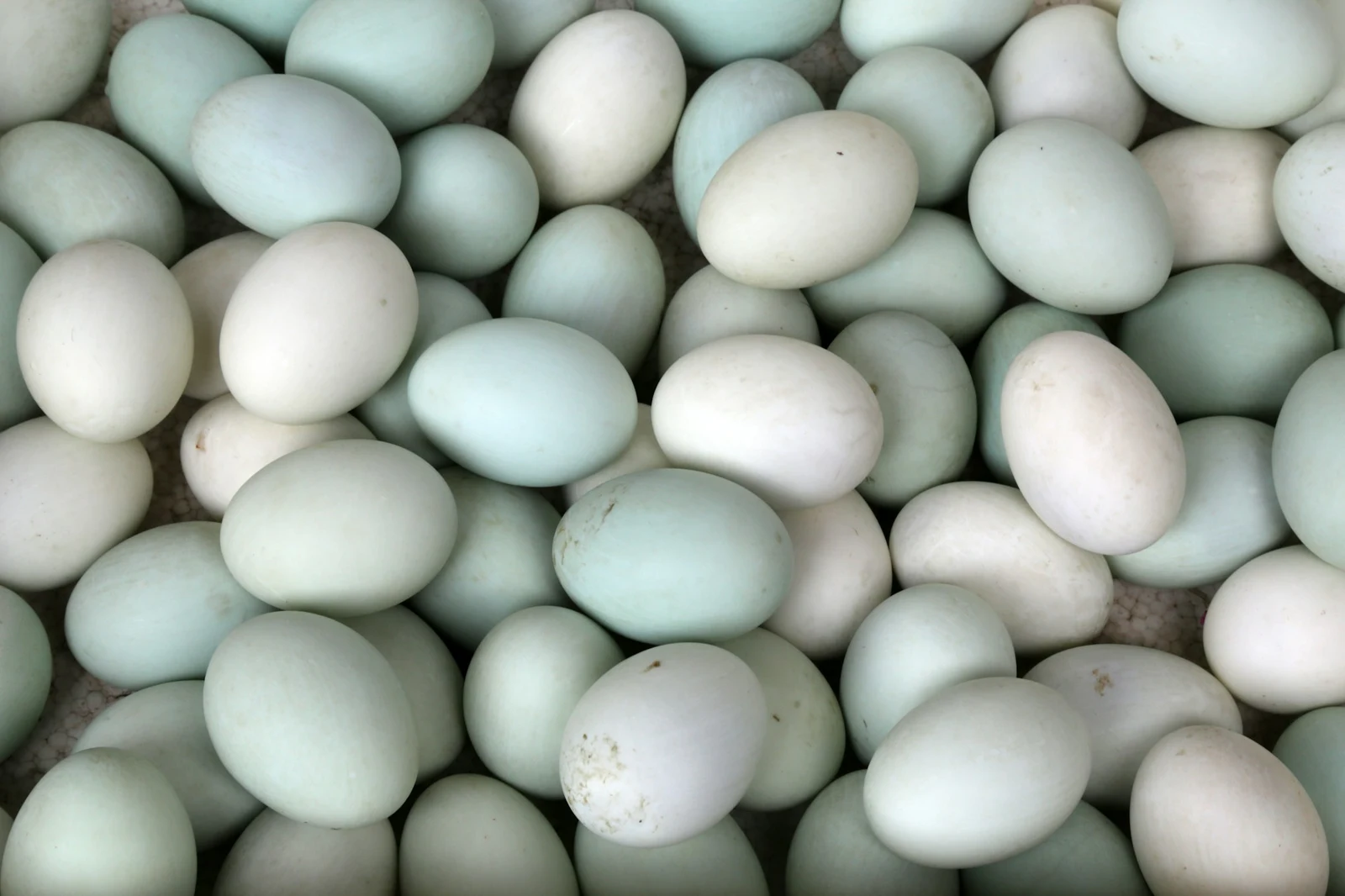 Duck Eggs
 Eggs - Chicken - Duck - Quail